Destruction as the final treatment step
Concentrated PFAS streams require molecular bond cleavage.
Destruction follows concentration.
Collection confines PFAS to a manageable stream.
However, the molecular structure remains unchanged.
Persistent compounds require controlled bond disruption.
Once concentrated, destruction becomes technically feasible.
PFASDestructor is engineered to operate at this stage —
downstream of concentration — where persistence remains.
The treatment chain remains incomplete without controlled destruction.
Destruction requires controlled physical conditions
PFAS persistence is not overcome by force, but by controlling the physical and chemical conditions under which bond disruption occurs.
Engineered for deployment within existing treatment trains
Plasma-based destruction is not applied to diluted bulk water streams. It is positioned downstream of separation and concentration stages, where PFAS mass has already been reduced to a confined stream.
This configuration allows the system to operate independently of total hydraulic throughput. Capacity is defined by PFAS mass load rather than total water volume.
As a result, integration typically does not require redesign of upstream infrastructure. The unit is installed as a final treatment step, connected to the concentrated PFAS stream produced by existing collection technologies.
Energy demand scales with the concentrated load, enabling predictable operation and controlled performance within industrial environments.
In this configuration, controlled destruction becomes a practical extension of the treatment train — not a replacement of it.
Modular and scalable installation
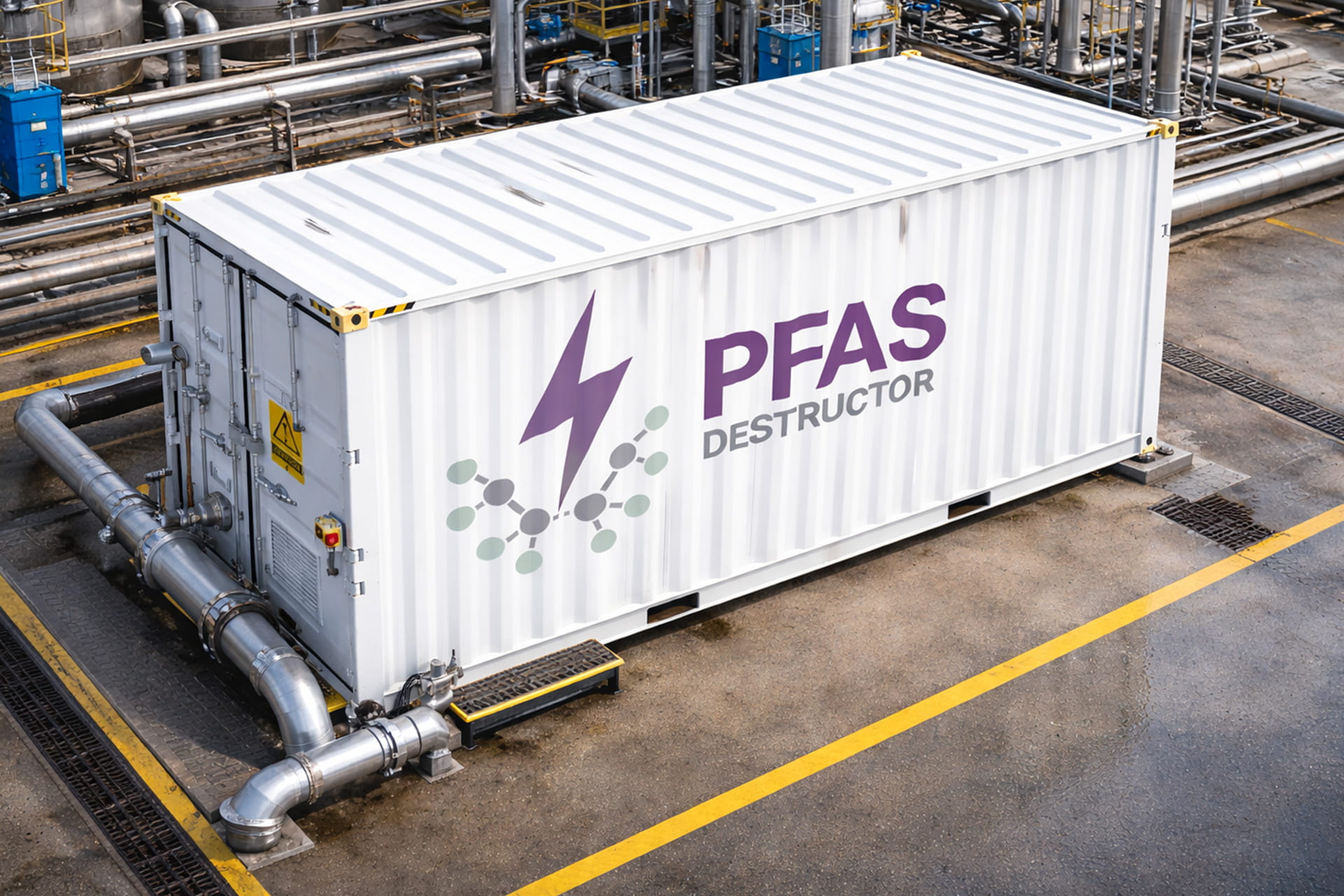
The system is delivered as a self-contained unit designed for industrial environments. It connects to an existing concentrated PFAS stream and operates independently of upstream hydraulic conditions.
Capacity can be scaled by increasing reactor volume or by operating multiple units in parallel. This modular approach allows deployment to match site-specific PFAS mass loads rather than fixed plant capacities.
Electrical connection and auxiliary utilities are integrated within the containerized system. Minimal structural modification of existing treatment infrastructure is typically required.
Deployment is therefore incremental, predictable, and adaptable to future regulatory or operational changes.
Adapted to existing infrastructure
Each installation begins with an assessment of the concentrated PFAS stream, including flow rate, PFAS mass load, temperature, and chemical composition.
System configuration is defined by the characteristics of the stream rather than by generic plant capacity. This ensures that reactor sizing, energy input, and operational parameters are aligned with actual site conditions.
No two installations are assumed identical. Engineering is performed case-by-case to ensure predictable performance within the constraints of existing infrastructure.
Integration therefore remains controlled, measurable, and technically transparent.

Predictable performance depends on disciplined engineering and site-specific configuration.
Designed for predictable operation
The system is built for industrial reliability. Operating parameters are defined, monitored, and adjustable within controlled ranges.
Destruction performance is measured at the concentrated PFAS stream level, allowing verification independent of bulk water fluctuations.
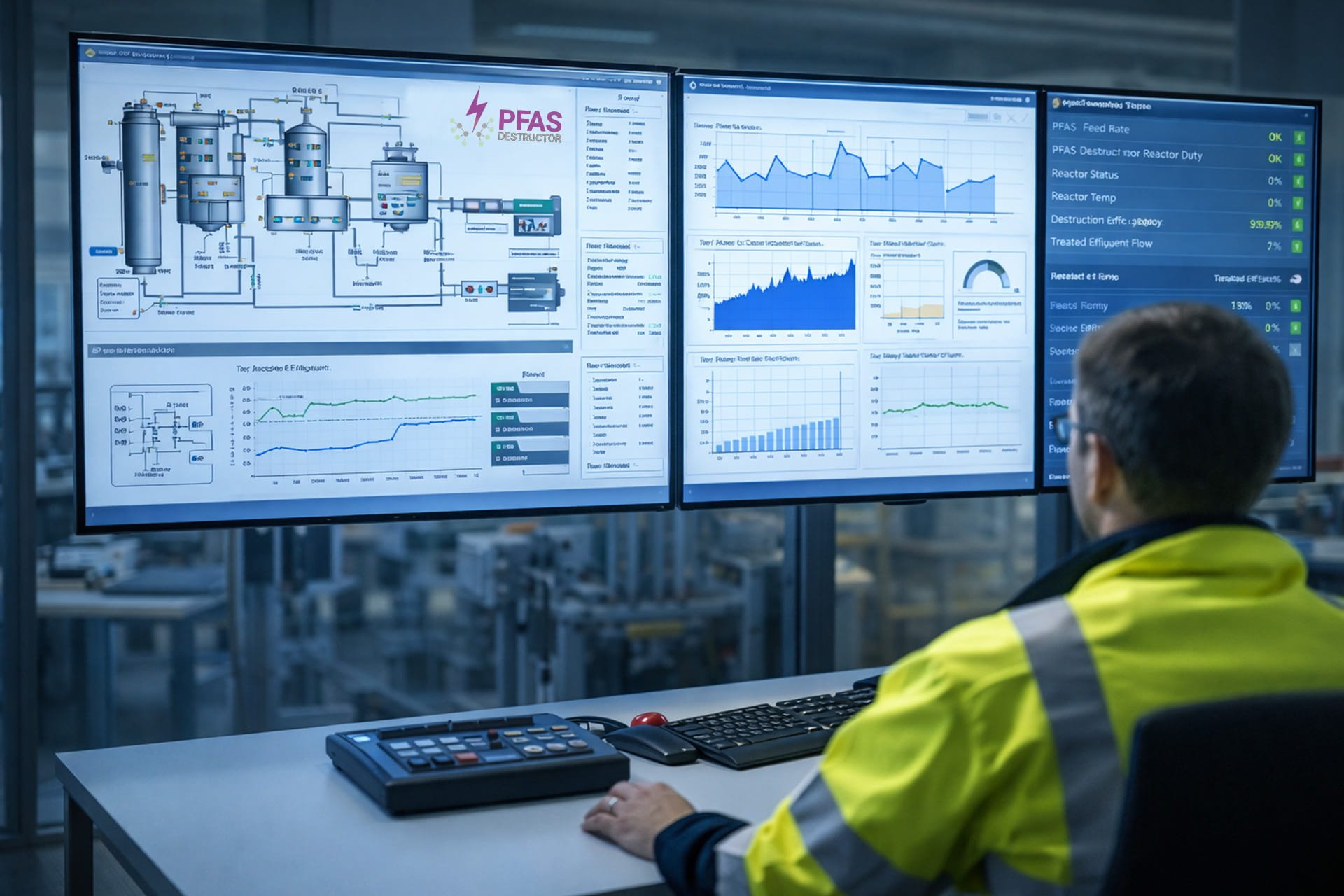
Control systems are integrated within the unit, providing transparent data on energy input, treatment conditions, and operational status.
This ensures that PFAS destruction remains measurable, stable, and accountable within regulated environments.
From concept to controlled deployment
PFAS destruction is only meaningful when it can be implemented within real industrial constraints.
PFASDestructor is designed to operate as a defined final step — positioned after concentration, integrated into existing infrastructure, and configured according to site-specific conditions.
Implementation is not standardized by assumption, but engineered through assessment. Performance is verified within the actual treatment context in which the system operates.
Controlled destruction becomes a measurable, controllable, and accountable part of the treatment chain.